~/posts/agentflow-multi-agent-assistant
AgentFlow: a multi-agent productivity assistant on Google ADK + MCP
- ai-agents
- mcp
- python
- gcp
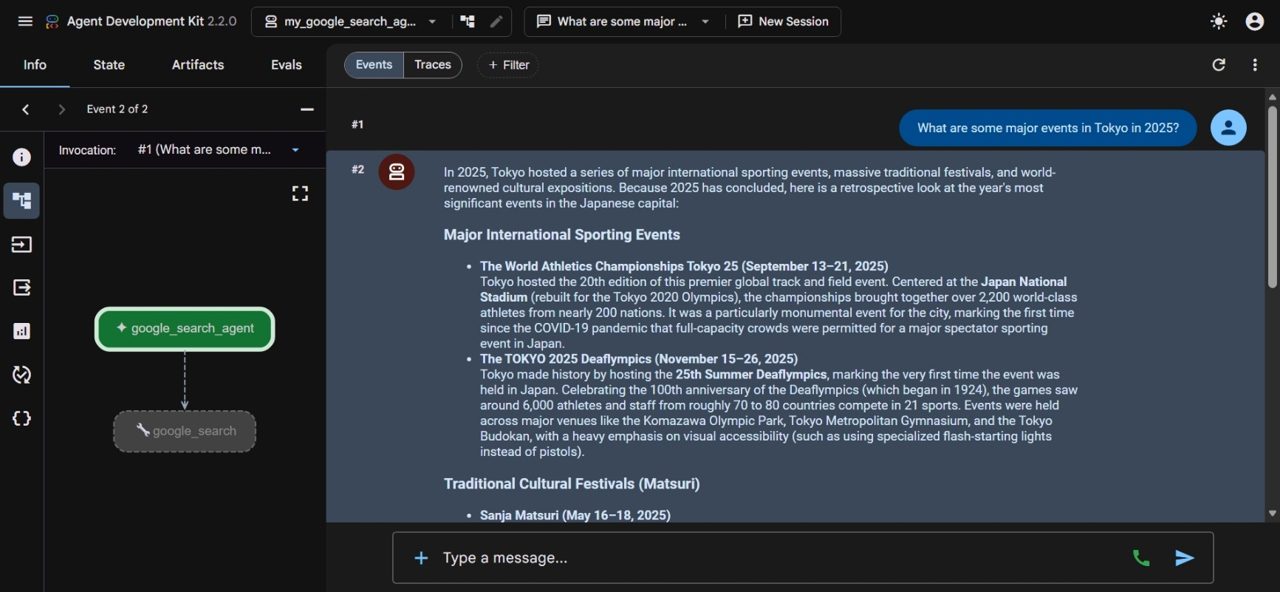
Single-agent assistants answer questions. Multi-agent assistants get work done — because each job gets its own specialist that can actually reach the tooling it needs. AgentFlow is my take on that architecture: a productivity assistant built with Google's Agent Development Kit (ADK), where an orchestrator plans work and routes it to modular sub-agents that own their own domains.
Repo: github.com/SabarishR08/agentflow-productivity-assistant
The fleet on the canvas — the assistant wired to its sub-agents in the Agent Development environment.
The fleet
The orchestrator coordinates six domain agents:
- calendar_agent — events and availability
- schedule_agent — scheduling logic across the day
- task_agent — to-dos and task state
- notes_agent — note capture and retrieval
- email_agent — draft and manage mail
- info_agent — general information lookup
Two pieces make the fleet more than a menu of functions:
- The orchestrator (agent + planner) decides which sub-agent should handle what, and in what order — so "block Tuesday morning for the project review and email the team" becomes a plan, not a single answer.
- MCP (Model Context Protocol) tools give agents a standard interface to external capability — the same protocol family that later showed up in MCP Guardian, where I defend it.
Deployment
AgentFlow is containerized (Dockerfile + cloudbuild) and deployed to Google Cloud Run, with an LLM API powering the agents and a frontend dashboard for interacting with the fleet.
The Engineer AI Agents with ADK challenge labs that came with the build — the training track behind the deployment.
Why build a fleet instead of one agent
- Separation of concerns — the calendar agent only needs calendar context; the notes agent only needs notes. Smaller, sharper prompts per agent, less context bleed.
- Tool ownership — each agent holds the credentials and tools for its domain, so no single agent juggles every integration.
- Plannable work — the orchestrator turns compound requests into ordered sub-tasks, which is also where the PromptShield Graph research plugs in: if agents hand work to each other, every handoff becomes an edge worth inspecting.
Status & next steps
Deployed prototype on Cloud Run. Next on the roadmap from the PromptShield Graph work: wiring cross-agent security into AgentFlow's live infrastructure and broadening the MCP server set.
Demo: drive.google.com/file/d/1ViRNneznyrWu20bb5PRlgl12_AsD3CZK